1. Following up on my point that parties need not to be hated, here, from before the election is some data on the ongoing de-toxification of the Conservative Party in some parts of the Midlands and the North. "Around 80-90% of why certain seats vote for certain parties is explained by the demographics of the area e.g. – how many graduates are there, how rich is the seat, how many people have gone to university, what is the ethnic composition and what type of jobs do people have". But some seats stand out (or did before the last election): they 'should' be Tory but, for historical/cultural reasons they are/were not: "the leave voting 55yr old plumber living in a detached house is more likely to vote Tory in Bournemouth than Wigan, even on the same salary. If the Tories manage to culturally de-toxify in certain seats there is a huge unlocked vote there". And Johnson managed, with help from Corbyn, to unlock that vote. (There are even people who did not vote Conservative who now wish they had.) I don't have the data to hand but it is not hard to think that one of Blair's great successes (with help from Major's failures in Government) was de-toxifying the Labour Party among people historically disinclined to vote Labour.
2. This is a tweet-storm from (what appears to be) a Labour Party member that is getting some publicity. The writer sets out the policies he would like. Some excerpts: "A ban on all foreign home/property ownership. Criminal sentences for landbankers. Then build an absolute shitload of council houses - but nice ones, terraces, with gardens, not Barrett-built lego sets made out of reconstituted cardboard", "A nice bit of military Keynesianism, uncompromising on security. A strong fleet, a strong RAF - all new military hardware to be built in Britain, by British workers. Make Barrow what it was 50 years ago. Renew Trident, and put a bloody Union Jack on it", "No more patronising nannying. Cut duty on fags and booze and stop lecturing people. Revive the Great British Pub and two fingers to the middle class Public Health Nazis". You get the picture. Speaking as someone who lives in London, he does not at all sound like a Labour supporter: in London terms, he sounds like a funny kind of Tory.
3. It seems that Lisa Nandy is the best hope for the Labour Party. I take it back about Jess Phillips: she is Matthew d'Ancona choice. Do you remember when Jacob Rees-Mogg and Jess Phillips used to pal around on TV together? Well, just as JRM is what an old northern socialist thinks a real Tory is like, JP is what a London softy like myself thinks a real Labourite is like. Sorry for the confusion.
Saturday, 21 December 2019

Friday, 20 December 2019
Tuesday, 17 December 2019
A way forward for the British Left?
Everyone has diagnosed the problem for the British Left: it is a coalition between upper middle class social liberals and poor people, and that coalition has broken down. Here's a good little piece on the problem, but you'll have seen plenty of others in a similar vein, many quoting Orwell.
Fine. But how is that problem to be solved? Answers below.
Fine. But how is that problem to be solved? Answers below.
Saturday, 14 December 2019
The 2017 election versus the 2019 election
Thursday, 5 December 2019
Some interesting things
1. Do you remember when Nixon gave his eulogy for the tragic loss of the astronauts on Apollo 11? No? But it's here. (Brilliant deepfake.)
2. "It’s been a long time now since, at age 53, I became a woman." The inimitable Deirdre McCloskey of course. Happy? Sad? Honest, anyway. "My daughter still lives in the Midwest; she is married and has a child. I’ve told in Crossing about how, a year later, when she was still in college, I saw her that one time, very early in my transition, a weeping father in a dress begging for a hug. ... Her lone letter in reply said “Thanks for the money. I still don’t want you in my life.” ... My son lives not too far from me. He too won’t speak."
3. Pregnancy reduces criminal behaviour, both for the mother and the father. There is some great economics-speak at the link: "pregnancy reduces discount rates and gives men and women a reason to invest in human capital and work for the future." Also: people should get married and have children earlier.
4. On "liberalism" and liberal societies. Well put.
5. Abortion. Again, well put, I thought, which is quite a feat when the author is an American calmly and sympathetically putting forward both sides of the debate.
6. Rory Sutherland, the Wiki Man. "One avenue that is rarely explored is that a major cause of the rise of populism might be the journalists themselves, and the extent to which the once noble aim of impartiality has led to something ridiculous — where almost everyone in authority is treated as a liar. // For the past three decades, Britain has had centrist governments led by mainstream politicians. And in that period, did we find that journalists devoted much airtime and column inches to reporting this as a good thing? We did not." To be fair, we are always fighting the last war. The "why is this lying liar lying to me?" type of interview is a reaction against the "Prime Minister, is there anything you would like to say?" interview of yesteryear. But I think Sutherland's point is a good one: even if deference is dead, common sense, decency and a sense of proportion ought not to be. And there is a market for long interviews that are not all bash-bash-bash: see podcasts.
7. Cheer up everyone! It's not that bad.
8. More on what happened to New Atheism.
9. Is there a more predictably awkward social interaction than buying the Big Issue? This morning I walked past the vendor, aware that I had no change, then, appreciating that I did have a note, I walked back to him. I gave him £10 and asked if he had change. I'll see, he said. It was cold. He reached into his pocket and brought out a handful of pound coins. The Big Issue costs £3. I had already decided that I would pay £5. I could see that he had 6 £1 coins in his cold hand. He counted them into my gloved hand one by one. His breath condensed in great clouds as he counted the £1 coins. Three. Four. I waited. I took my £5, said thank you and walked away feeling like an idiot. Anyway all of that is just a prelude to this:
 Look at the order of the politicians. At the last general election, the LibDems got about 2.4m votes and the SNP got under 1m. (Did you know that more Scottish people voted Leave in the 2016 referendum than voted for the SNP in 2017: 1,018,322 versus 977,568?) And yet there is Sturgeon on the top line, with Swinson sitting at the children's table. Yes I know, number of MPs, percentage of vote in seats contested, yes, yes, yes. But surely, not so long ago, the leader of the third national party would rank above a regional separatist?
10. How humans and other modern animals would look if drawn from their skeletons in the same way dinosaurs are, if you see what I mean.
2. "It’s been a long time now since, at age 53, I became a woman." The inimitable Deirdre McCloskey of course. Happy? Sad? Honest, anyway. "My daughter still lives in the Midwest; she is married and has a child. I’ve told in Crossing about how, a year later, when she was still in college, I saw her that one time, very early in my transition, a weeping father in a dress begging for a hug. ... Her lone letter in reply said “Thanks for the money. I still don’t want you in my life.” ... My son lives not too far from me. He too won’t speak."
3. Pregnancy reduces criminal behaviour, both for the mother and the father. There is some great economics-speak at the link: "pregnancy reduces discount rates and gives men and women a reason to invest in human capital and work for the future." Also: people should get married and have children earlier.
4. On "liberalism" and liberal societies. Well put.
5. Abortion. Again, well put, I thought, which is quite a feat when the author is an American calmly and sympathetically putting forward both sides of the debate.
6. Rory Sutherland, the Wiki Man. "One avenue that is rarely explored is that a major cause of the rise of populism might be the journalists themselves, and the extent to which the once noble aim of impartiality has led to something ridiculous — where almost everyone in authority is treated as a liar. // For the past three decades, Britain has had centrist governments led by mainstream politicians. And in that period, did we find that journalists devoted much airtime and column inches to reporting this as a good thing? We did not." To be fair, we are always fighting the last war. The "why is this lying liar lying to me?" type of interview is a reaction against the "Prime Minister, is there anything you would like to say?" interview of yesteryear. But I think Sutherland's point is a good one: even if deference is dead, common sense, decency and a sense of proportion ought not to be. And there is a market for long interviews that are not all bash-bash-bash: see podcasts.
7. Cheer up everyone! It's not that bad.
8. More on what happened to New Atheism.
9. Is there a more predictably awkward social interaction than buying the Big Issue? This morning I walked past the vendor, aware that I had no change, then, appreciating that I did have a note, I walked back to him. I gave him £10 and asked if he had change. I'll see, he said. It was cold. He reached into his pocket and brought out a handful of pound coins. The Big Issue costs £3. I had already decided that I would pay £5. I could see that he had 6 £1 coins in his cold hand. He counted them into my gloved hand one by one. His breath condensed in great clouds as he counted the £1 coins. Three. Four. I waited. I took my £5, said thank you and walked away feeling like an idiot. Anyway all of that is just a prelude to this:

10. How humans and other modern animals would look if drawn from their skeletons in the same way dinosaurs are, if you see what I mean.
Friday, 29 November 2019
Poor young women
As I mentioned before, the BBC reported that, in England, "Among 16 to 24-year-old women in 2014, 19.7% reported having self-harmed at some point in their life", a growing trend.
It also appears that "more than a third of UK women under the age of 40 have experienced unwanted slapping, choking, gagging or spitting during consensual sex" (again from the BBC). In addition to the "unwanted" occurrences, there have also been a large number of "wanted" ones:
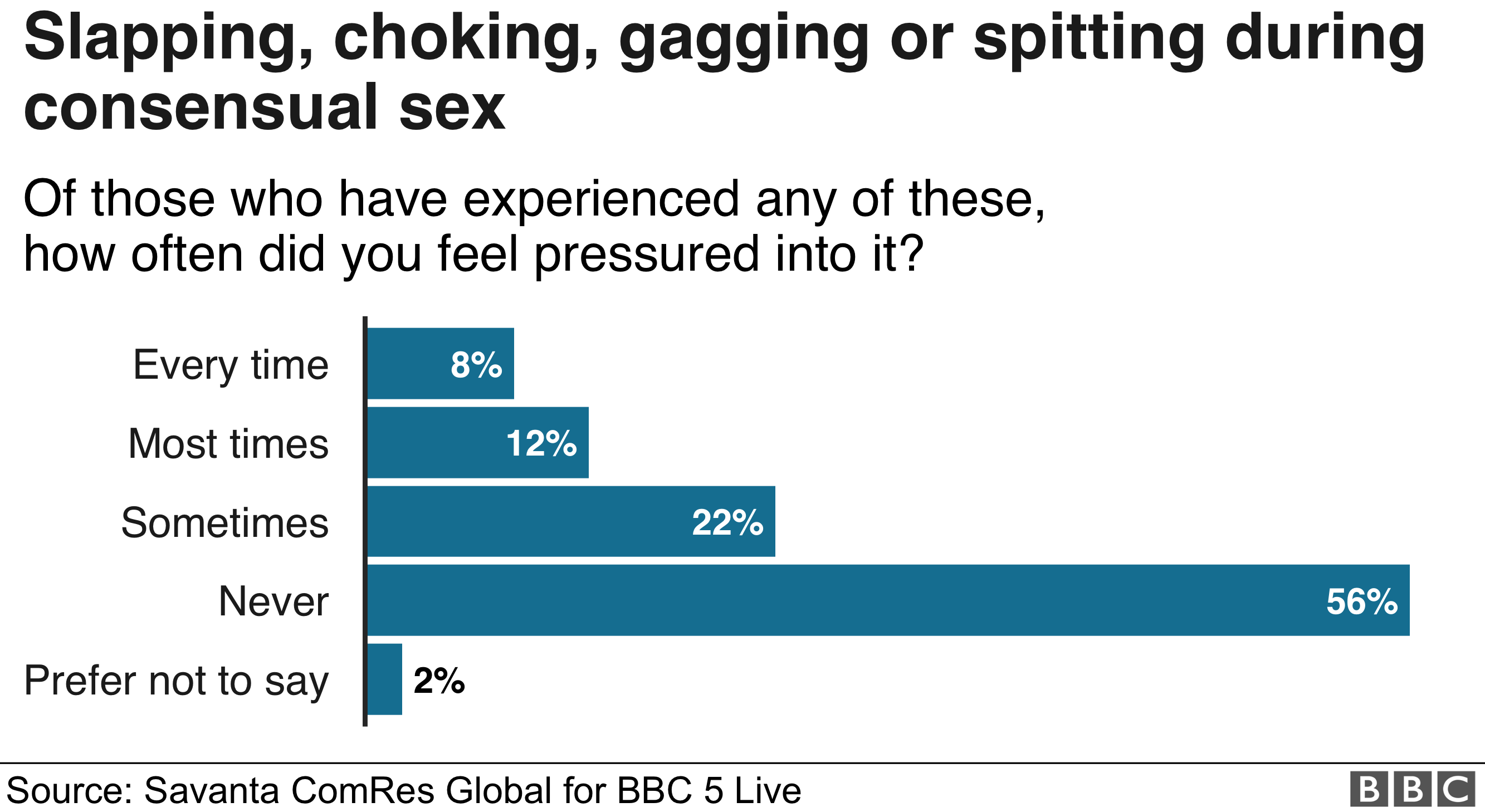
I'm not going to go all statistics-y on this: England is not the same as the UK; 16-24 year olds are not the same as 18-39 year olds; survey reports about personal stuff like this are no doubt less reliable than "did you eat a sandwich for lunch"-type surveys. (Also: I can't make full sense of the statistics in this piece. On the one hand, the above graph suggests that the majority of these kinds of activities were "unpressured", on the other hand, "More than a third (38%) had experienced these acts and said they were unwanted at least some of the time, while just under two-thirds of women had either experienced it and said it was never unwanted (31%), or they had no experience, didn't know or preferred not to say (31%)." Is the 38% in that quotation the same people as the 42% in the graph above? One reading of this is that most women experience these activities, but they are mostly "wanted" or "unpressured". I don't think that is what the article says, but I can't be certain.)
But the long and the short of it is that there is a large number of young women in this country who are the victims of violence, a lot of it "consensual", i.e. inflicted by themselves on themselves or by their partners on themselves, and a lot of it is straightforwardly non-consensual.
I am far from alone in thinking that self-harm, consensual though it is obviously is, is a Bad Thing. Worrying. A sign of disturbance, unhappiness or mental illness. No one in the article on self-harm regards its increase as an interesting development in leisure activities for young women: it is something "alarming", something that needs "prevention" and "intervention".
So why should we treat the "consensual" infliction of harm by sexual partners any differently? Indeed, the BBC article treats the whole business of violence during sex as a Bad Thing, consensual or not: "People do it because they think it's the norm but it can be very harmful. What we see is that for many, it devalues the relationship but - at its worst - violence becomes acceptable". Quite: as with self-harm, consent to the injury is a sign that things are bad, not good.
The modern rule for sexual morality is "always and everywhere, consenting adults = ok". I say "modern", but, what with the #MeToo movement and now violence during sex, it is already looking rusty and obsolete. But, having abandoned Christianity, what do we have to replace it?
It also appears that "more than a third of UK women under the age of 40 have experienced unwanted slapping, choking, gagging or spitting during consensual sex" (again from the BBC). In addition to the "unwanted" occurrences, there have also been a large number of "wanted" ones:
I'm not going to go all statistics-y on this: England is not the same as the UK; 16-24 year olds are not the same as 18-39 year olds; survey reports about personal stuff like this are no doubt less reliable than "did you eat a sandwich for lunch"-type surveys. (Also: I can't make full sense of the statistics in this piece. On the one hand, the above graph suggests that the majority of these kinds of activities were "unpressured", on the other hand, "More than a third (38%) had experienced these acts and said they were unwanted at least some of the time, while just under two-thirds of women had either experienced it and said it was never unwanted (31%), or they had no experience, didn't know or preferred not to say (31%)." Is the 38% in that quotation the same people as the 42% in the graph above? One reading of this is that most women experience these activities, but they are mostly "wanted" or "unpressured". I don't think that is what the article says, but I can't be certain.)
But the long and the short of it is that there is a large number of young women in this country who are the victims of violence, a lot of it "consensual", i.e. inflicted by themselves on themselves or by their partners on themselves, and a lot of it is straightforwardly non-consensual.
I am far from alone in thinking that self-harm, consensual though it is obviously is, is a Bad Thing. Worrying. A sign of disturbance, unhappiness or mental illness. No one in the article on self-harm regards its increase as an interesting development in leisure activities for young women: it is something "alarming", something that needs "prevention" and "intervention".
So why should we treat the "consensual" infliction of harm by sexual partners any differently? Indeed, the BBC article treats the whole business of violence during sex as a Bad Thing, consensual or not: "People do it because they think it's the norm but it can be very harmful. What we see is that for many, it devalues the relationship but - at its worst - violence becomes acceptable". Quite: as with self-harm, consent to the injury is a sign that things are bad, not good.
The modern rule for sexual morality is "always and everywhere, consenting adults = ok". I say "modern", but, what with the #MeToo movement and now violence during sex, it is already looking rusty and obsolete. But, having abandoned Christianity, what do we have to replace it?
Tuesday, 26 November 2019
Jon Kelly - part 2
I once came across a journalist called Jon Kelly. I made fun of him (just a little bit). He replied. He was, I think, not upset, but I suppose I felt a little bad about it.
So I decided to look him up again - and I am pleased that I did. Kelly is now working on BBC Stories and he is doing some really good stuff. Here are some examples.
- This is about a woman prisoner.
- This is about a woman who married two haemophiliacs - and was widowed twice, by the same infected blood scandal.
- This is about how hard employment is when you have dementia.
And there are more.
Each of the ones I have read is a proper article, interesting or affecting as the story demands. They also reflect well on Kelly: these are people currently facing, or at least remembering, some pretty hard times, and he treats their stories with care and respect. I recommend that you forget about politics for a few moments, read a couple of his articles and you'll be reminded why you pay your licence fee.
The BBC was wasting Kelly by getting him to write frivolous rubbish. But now he is doing what he should be doing. Well done to both of them.
So I decided to look him up again - and I am pleased that I did. Kelly is now working on BBC Stories and he is doing some really good stuff. Here are some examples.
- This is about a woman prisoner.
- This is about a woman who married two haemophiliacs - and was widowed twice, by the same infected blood scandal.
- This is about how hard employment is when you have dementia.
And there are more.
Each of the ones I have read is a proper article, interesting or affecting as the story demands. They also reflect well on Kelly: these are people currently facing, or at least remembering, some pretty hard times, and he treats their stories with care and respect. I recommend that you forget about politics for a few moments, read a couple of his articles and you'll be reminded why you pay your licence fee.
The BBC was wasting Kelly by getting him to write frivolous rubbish. But now he is doing what he should be doing. Well done to both of them.
Subscribe to:
Posts (Atom)